


30 Years
Long-Term Financial Commitment

$250M+
Estimated Total Cost with Interest
$68/month
Average Household Impact
Long-Term Financial Commitment
Estimated Total Cost with Interest
Average Household Impact
Measure 2-379 asks Florence taxpayers for a $139 million principal bond. When accounting for interest over 30 years, the total cost to our community may exceed $250 million. This represents a massive expansion of public debt during a time of significant economic uncertainty.
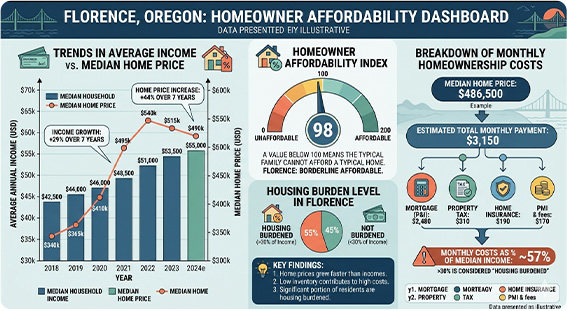
For the median Florence household income ($59,539), an additional tax burden of $783 annually is a burden that families and seniors on fixed incomes simply cannot afford.
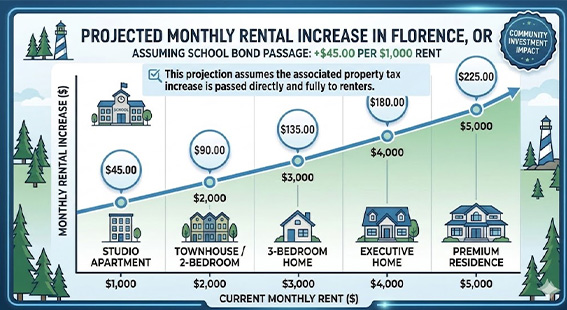
Property tax increases are passed directly to tenants. Median renters in Florence can expect annual rent hikes of $300–$500 annually to cover this bond.
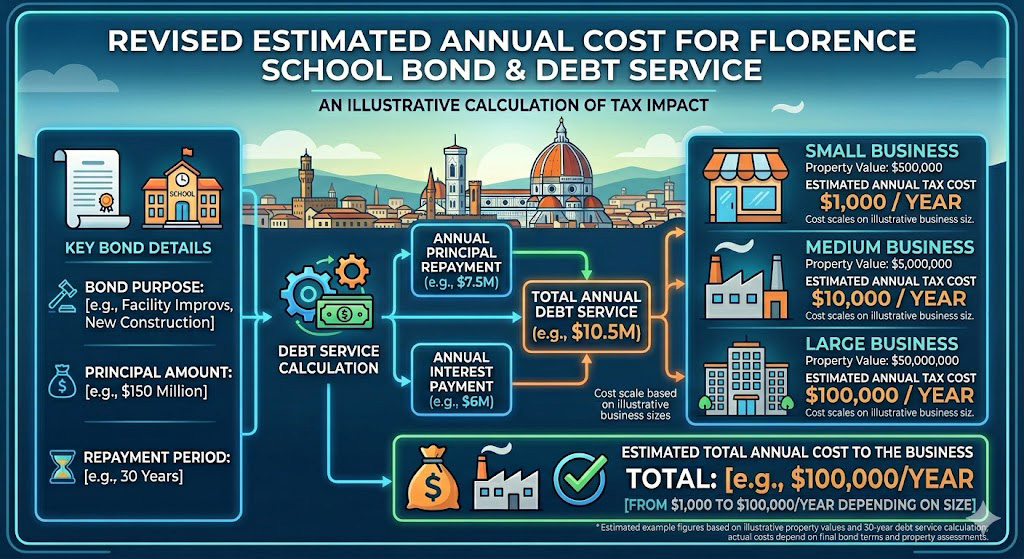
School bonds in Oregon place a significant, direct property tax burden on businesses through levies on assessed value. Unlike residential homeowners, businesses often hold higher-value property, meaning they bear a higher share of the tax increase required to pay off the bond debt.

As of 2024, Florence had a high average vacancy rate of 48.92% across all asset classes. The national average for commercial vacancy is 17-20%.
Increasing the tax burden on commercial landlords will likely increase the commercial vacancy rate and drive more small businesses out of Florence while making our city less attractive for new businesses.
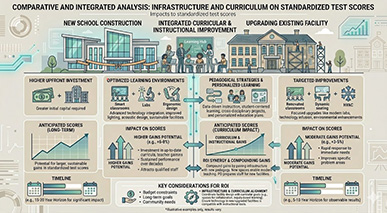
The consensus among educational researchers is that the condition of the building matters more than its age. A well-maintained 1970s school with modern HVAC, lighting, and acoustics can produce academic results similar to a newer building. The impact on test scores is almost entirely tied to the physical health and comfort of the students and teachers. Claiming the current school is “beyond repair” admits to decades of failed maintenance oversight. Taxpayers should not be the “bailout” for administrative mismanagement and neglect.
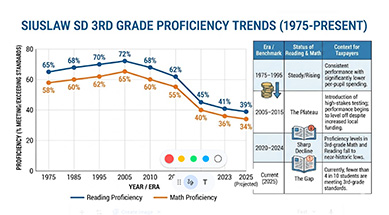
For school year 2024-2025, the Oregon Department of Education report card shows Siuslaw High School at a 3 year low for English Language Arts proficiency at 27.9 percent, and mathematics at 21.2 percent, neither of these meet state standards.
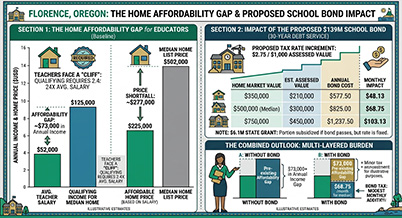
Adding a tax increase via the bond to Florence teachers, who are already paid below the average in Oregon, will further decrease a teacher’s take-home pay and push homeownership even further out of reach.
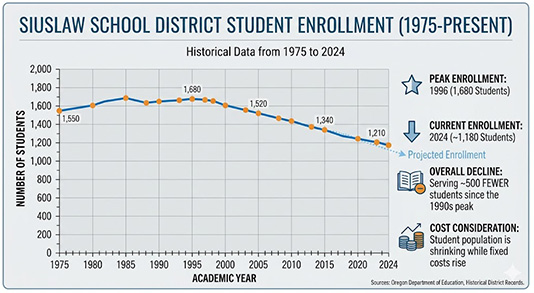
District data shows a steady decline in student population with peak attendance of 1680 students in 1995 to 1180 students currently, a 30% decrease. Building a massive new 174,000 sq. ft. high school for a shrinking student body (376 students as of Nov/2025) is poor financial stewardship of taxpayer dollars.
School shootings have occurred in buildings of varying ages, ranging from historical 19th-century structures to modern facilities. While some incidents occurred in older, renovated buildings, others happened in newly constructed schools indicating that the year of construction is generally less significant than security, behavioral, and access factors. Recent studies, such as the K-12 School Shooting Database, focus on the location of parking lots, classrooms, hallways etc. rather than the building age.
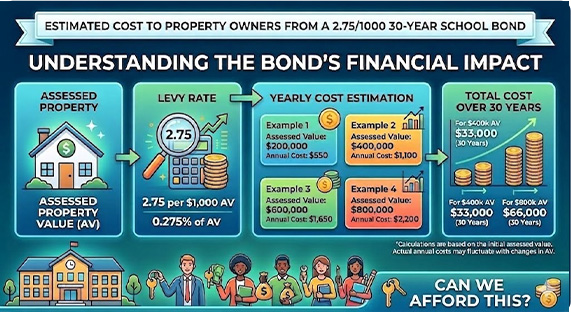
The proposed bond carries an estimated tax rate of $2.75 per $1,000 of assessed property value. Unlike market value, assessed value in Oregon typically grows by 3% annually, meaning the tax burden will increase over the life of the bond.
Florence has a significant population of retirees. This bond creates a unique risk for those on non-adjustable incomes:
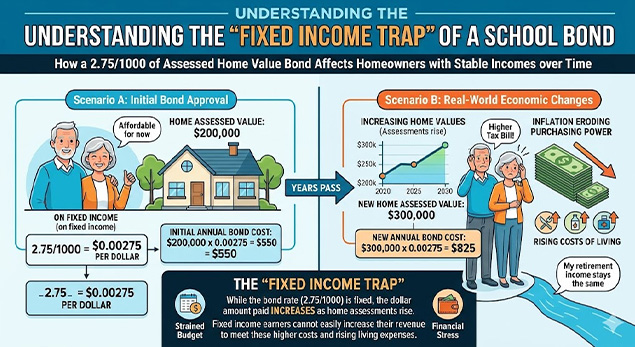
Unlike the district budget, Social Security and fixed pensions do not automatically increase to cover new tax assessments.
A monthly increase of $50–$100 can force difficult choices between property taxes and essential costs like healthcare or utilities.
Increased carrying costs may force long-term residents to sell their homes despite having no mortgage.
Critics argue that residents are already paying taxes for facility maintenance through the general fund. This bond is viewed as a "second payment" for repairs that should have been managed through existing annual budgets.
This bond ties up the community’s credit for three decades, limiting the ability to fund other infrastructure emergencies.
Over 30 years, the total cost to taxpayers will far exceed the $139 million principal, with significant portions of tax revenue going to interest payments for bondholders.
Voters have previously rejected smaller requests ($40M in 2016 and $108M in 2018). Opponents argue that the district should return with a more modest maintenance and retrofit plan rather than a total facility replacement.
Measure 20-379 asks Florence taxpayers for a $139 million principal bond. When accounting for interest over 30 years, the total cost to our community will exceed $250 million. This is not a "renewal"—it is a massive expansion of public debt during a time of significant economic uncertainty.
For the median Florence household, this bond represents a significant extraction of private wealth. With a median household income of $59,539, a new $783 annual tax is a burden that families and seniors on fixed incomes simply cannot afford.
Conservative educational policy asserts that student achievement is driven by standards, not surroundings. A $139 million building will not inherently improve math or reading proficiency.
Funding should be directed toward curricular rigor, teacher quality, and vocational training. A school building is a depreciating asset; high-performing students are the real community investment.
The district must prove academic success within current facilities before asking for a "premium" upgrade. We should not reward stagnating test scores with a quarter-billion-dollar construction project
Claiming the current school is "beyond repair" admits to decades of failed maintenance oversight. Taxpayers should not be the "bailout" for administrative negligence.
Excessive property taxes lower the desirability of a community for new homebuyers and small businesses.
Don't lock Florence into a debt obligation that lasts until 2056.
A "No" vote forces the district to return with a modest, fiscally responsible proposal that addresses essential safety repairs without bankrupting the middle class.
Let’s prioritize a "back-to-basics" curriculum that ensures Florence graduates are career-ready, regardless of the building’s age.
Every dollar spent on bond interest is a dollar that cannot be spent on teachers, books, or specialized student programs.
This measure locks the Florence community into a high-interest debt cycle until the year 2056.
If your home's assessed value increases over the next 30 years, your $68/month payment will also go up, even if your income stays the same.
When you take out a 30-year mortgage, you pay for the house plus the interest.
This school bond is no different. While the district asks for $139 Million, taxpayers will likely pay back over $250 Million once interest and bond issuance fees are
A $139 million principal that grows with interest.
$68.75/month for the average family.
Investing that same money directly into curriculum rigor and teacher retention today—without the 30 years of interest payments to big banks.

Investing in physical facilities via bonds is generally categorized as "removing barriers to learning."
Research consistently shows that "substandard" environments (poor ventilation, extreme temperatures, or inadequate lighting) create a physiological drag on performance. A bond measure that fixes a failing HVAC system is not necessarily "boosting" scores so much as it is stopping the environment from actively depressing them.
Beyond academics, bonds impact the community’s "social capital." Modern facilities can improve teacher retention, reduce absenteeism, and increase local property values, which indirectly stabilizes the tax base for future school funding.
The data suggests a "plateau effect." Moving a student from a crumbling building to a clean, functional one yields a measurable gain. However, moving a student from a functional building to a high-tech "luxury" facility shows significantly less correlation with academic growth.
Investing in curriculum and professional development is categorized as "enhancing the quality of learning."
Curriculum dictates the cognitive demand placed on a student. A rigorous curriculum (characterized by high-depth-of-knowledge tasks) has a more direct, linear relationship with test scores and college readiness.
Relative to a multi-million dollar construction bond, updating a curriculum or providing teacher coaching is often less expensive in terms of capital outlay. However, it requires a higher "human cost" in terms of time, training, and consistent implementation.
A curriculum is only as rigorous as its delivery. While a new building "works" as soon as the doors open, a new curriculum often requires years of teacher adaptation before the full benefits are reflected in student data.
The most balanced view held by educational economists is that infrastructure is a prerequisite, while curriculum is the engine. If a school's physical conditions are "standard" (clean, safe, and temperate), the marginal dollar spent on curriculum rigor and teacher training typically produces a higher academic return than the marginal dollar spent on further facility upgrades. Conversely, if a building is "dilapidated," even the most rigorous curriculum may fail to land because the environment prevents the necessary concentration.